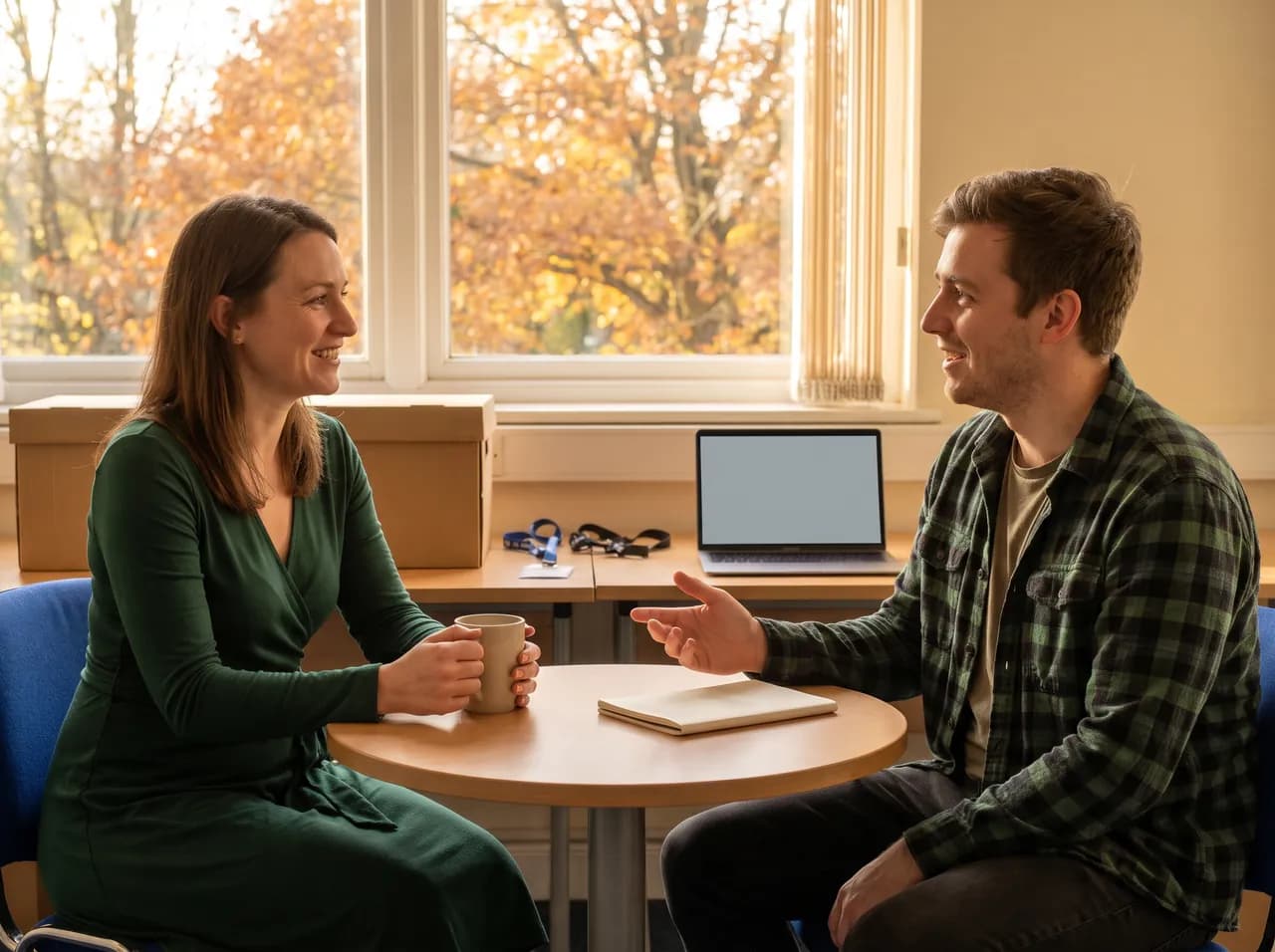
First impressions in interviews: what the first few minutes decide
Studies of interviews find that rapport in the opening minutes predicts the final rating and even the offer. How to keep a warm welcome from becoming a hidden test, and how to structure the opening so first impressions do less work.
September 30, 2025

Key takeaways
- Barrick, Swider and Stewart (2010) found that initial impressions formed in the rapport-building stage predicted interviewers’ later evaluations and employment offers.
- Small talk is not neutral: people who are more at ease socially, or who share the interviewer’s background, gain an advantage unrelated to the job.
- Keep the welcome warm and separate from scoring. Score only answers to the planned questions.
- Write your impression down after scoring, so you can see whether it adds anything.
In this article
Many interviewers say they decide within the first few minutes, and many more do so without admitting it. The research suggests they are not exaggerating: what happens in the opening predicts a good deal of what comes after.
What the research found
Barrick, Swider and Stewart (2010) studied how initial impressions, formed during the rapport-building stage before the formal questions begin, related to the outcome of the interview. Impressions formed in those first moments predicted the interviewers’ final evaluations and the employment offers that followed. The effect did not disappear when the researchers took other information into account. The opening was doing more work than anyone intended.
This fits a wider finding in social psychology about “thin slices”: Ambady and Rosenthal (1992) found that observers’ quick judgements based on brief exposure to behaviour could predict later outcomes. The point is not that snap judgements are always wrong. It is that they are fast, confident and strongly influenced by things that are not the job: voice, confidence, appearance, accent, shared interests and ease of conversation.
Why this matters for fairness
The people who are most at ease in a first conversation are not necessarily the best at the work. Some are naturally outgoing, some have been coached, some share the interviewer’s background and some are more comfortable in the language of the interview. Others are anxious, neurodivergent, shy, speaking a second language or unused to the conventions of professional small talk. If the first minutes carry heavy weight, the process quietly rewards the first group.
Keep rapport, remove its weight
Warmth matters. Candidates perform better when they feel welcome, and an interview should treat people with respect. The aim is not to be cold. It is to make sure warmth does not turn into a hidden test.
| Instead of | Do this |
|---|---|
| Opening with open small talk (“Tell me about yourself”) and forming a view | Open with a short, fixed welcome: who is in the room, how long it will take, what will happen, and when you will reply |
| Letting rapport shape the score | Tell yourself, and the candidate, that scoring starts at the first planned question |
| Probing deeply on topics you enjoy | Ask the same questions of every candidate and the same follow-ups |
| Judging style (fluency, confidence) | Score the content of the answer against the anchors on the scorecard |
| Recording an overall feeling first | Score each criterion first, then note your impression separately |
A five-line opening you can use
- “Thank you for coming. I’m [name], and with me is [name].”
- “We have 45 minutes. I will ask the same questions of every candidate, and take notes.”
- “We will start with some questions about your experience, then you can ask us anything.”
- “If you need a question repeated or want a moment to think, just say so.”
- “We will let you know our decision by [date].”
This is warm, short and the same for everyone. It also tells the candidate how the interview works, which helps people who find unwritten social rules hard.
Track your own impressions
One habit is worth building. After each interview, once the criterion scores are written, record your overall impression in one line. After ten interviews, compare those impressions with the scores and, later, with how people did. You may find your first impressions are better than you feared. You may find the opposite. Either way, you will know.
Remote interviews
On video, first impressions also pick up lighting, camera quality and background. These say nothing about ability. Briefing candidates on the format in advance, and judging only the answers, helps.
A five-question self-check after every interview
After you have written your criterion scores, answer these in a line each. They take two minutes, and they show you where first impressions crept in.
- What did I think of this person in the first five minutes?
- Did that impression change by the end? Why?
- Which of my scores would be different if I had forgotten the first five minutes?
- Did I give more time or warmer follow-ups to this candidate than to others?
- Is there anything I liked that is not on the scorecard?
If the answers to the first and third are both “a lot”, look at the scores again with the evidence in front of you. Over time, the notes build a record of how your own impressions relate to what you later learn about people.
A training exercise for teams
Play interviewers a recorded answer twice: once with the video, once as a transcript only. Ask them to score both. The differences in score are the part of the rating that comes from presence and style, not content. Seeing the gap in their own scores makes the point more effectively than any lecture, and the exercise needs only an hour and a few recorded answers, with candidates’ consent or using colleagues in role-play.
About the author
Nora Lindqvist, Talent acquisition advisor
Nora helps hiring teams improve the candidate journey, from job descriptions and screening at volume to remote interviews and the final decision. She writes about making demanding processes clear and humane.